
Vandalized Beauty
Another strategy revealed

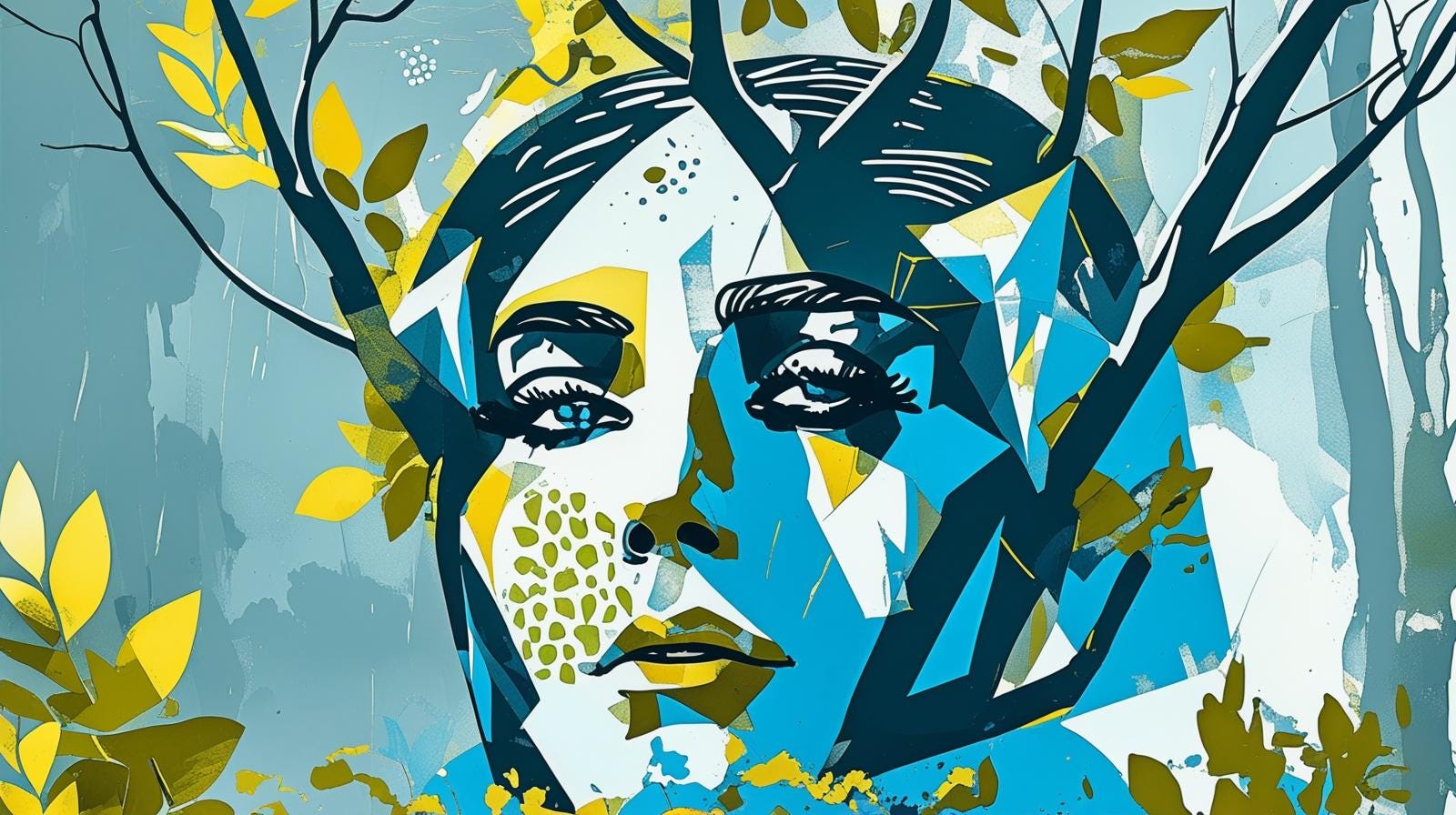
N.J.’s Personal Anecdote:
Whenever I want to see God, I go for a walk. Creation has a way of reminding me of our matchless Creator, and the splendor of tree canopies moves me to reverence. During a walk some time ago, I considered that the naturally occurring grass flanked the unnatural concrete sidewalk—that which was created vs. that which was made. I heard in the spirit ‘toiling on the left, riches on the right.’ I remembered that there was a related scripture, and a quick search brought me to John 21:6 (ERV), where it says, “He said, ‘Throw your net into the water on the right side of your boat. You will find some fish there.’ So they did this. They caught so many fish that they could not pull the net back into the boat.”
The left hemisphere of the brain is associated with logic and reason, while the right hemisphere is linked to creativity and imagination. And yet, Jesus Christ told the fishermen to cast their nets to the right after they had their nets on the left all night and caught no fish.
Then, while exploring the book Tree of Souls: The Mythology of Judaism by Howard Schwartz, I unexpectedly came across a part that connected this idea of God’s beauty and creation:
Creation by God’s Beauty
The world was created by God’s beauty: the deeps were set ablaze by His beauty, the firmaments were kindled by His radiance. The angels burst out of His stature, the mighty exploded from His crown, and the precious erupted from His garment. And all of the trees and grasses came forth exulting from His joy.
This myth is found in a hymn… describing heavenly journeys. In this unusual myth, creation is described as having been kindled by God’s beauty… But here, it is God’s attribute of beauty that is identified as the creative element that gives birth to the creation of the world.
Later in this hymn, God is described as a cosmic tree, “who covered the heavens with His glorious bough, and appeared from the heights in His majesty.”
Of course, the Holy Spirit likes to drive further confirmation of an idea with additional evidence. Test every spirit, right? A video titled “How the stripping of beauty led us back to a primitive state” from the YouTube channel The War on Beauty appeared on my feed. Intrigued by the title, I tuned in. Although the host spoke in historical and artistic terms, several quotes from artists and philosophers featured beauty as a spiritual concept. For example, Friedrich Schiller’s book On the Aesthetic Education of Man is quoted saying, “It is therefore not only a poetical license, but also philosophically correct, when beauty is named our second creator.” A striking correlation noted in the video was that as things became increasingly ‘ugly,’ human liberty declined, followed by an increase in immorality.
As she discussed the topic further, the present-day fashion industry came to mind. Minimalist, near-colorless styles have been dominating stores for several years now, and until now, no spiritual implications have been considered. Things have gotten so bad that a growing number of brands are reaching into their archives for styles and pieces to sell to consumers, as if modern designers lack the aesthetic talent that designers and inventory buyers of prior years possessed. Of course, there is some level of rationality to apply to the trend, given how long quarantines, lockdowns, and remote work lasted, leaving a tiny incentive to be fashionably expressive. Coincidentally, over the last decade or so, faith and religion became a taboo topic socially; meanwhile, popular culture was dominated by sci-fi, witchcraft, and alternative spirituality.
Could this be yet another strategy of the opposition revealed?
Reflecting on this further, the matter of God’s beauty connects to the mystery of Philippians 4:8, “Finally, brothers and sisters, whatever is true, whatever is noble, whatever is right, whatever is pure, whatever is lovely, whatever is admirable—if anything is excellent or praiseworthy—think about such things.” It’s one thing to think positively, but Philippians 4:8 communicates a required beauty in thinking.
Similarly, Proverbs 11:23 takes on a slightly different meaning: “The desire of the righteous ends only in good, but the hope of the wicked only in wrath.” This verse communicates that there is an ugliness in the thoughts and expectations of the wicked (the unloving).
Consider how the author of Proverbs, King Solomon, even made a point of prioritizing beauty, opulence, and luxury when building the First Temple for God in 1 Kings 6.
Circling back to this wisdom being environmental, there is a natural irregularity to creation, yet it still feels balanced. This is what makes litter and trash appear so out of place, like vandalism. The bible says in 1 Corinthians 6:19 that our bodies are the temple of the Holy Spirit. When we feel spiritual deadness or emptiness, we start to vandalize ourselves, as litter vandalizes the beauty of nature. Self-vandalism could manifest itself as negative self-talk, being very self-critical, self-harm (call or text 988 for support), eating disorders, low self-esteem, etc. A message from The Rock Church in San Diego, California, summarized the idea of being spiritually dead, or empty, in a short message: “Why do I feel empty?” In the message, the speaker uses a glove as an analogy for us being in the image of God, and when we allow ourselves to be filled by God (the hand that fits in the glove), God lives inside us, giving us purpose (synonymous with love, beauty, and truth).
Affirm: I am made in the image and likeness of God, and divine light expresses itself through me. Today, I allow my authentic, beautiful self to shine and be a blessing to others.
Dear God,
Thank You for Your beauty. I repent for any time I have rejected the truth of being divinely and intentionally made. I lay every fear, every worry, every insecurity at the foot of Your throne and surrender to You. Increase my awareness of my identity in Christ —the divine spark within me —and of how I can best steward my body, the temple of Your Holy Spirit. Thank You for Your grace and mercy.
In Your Holy Name, Amen.